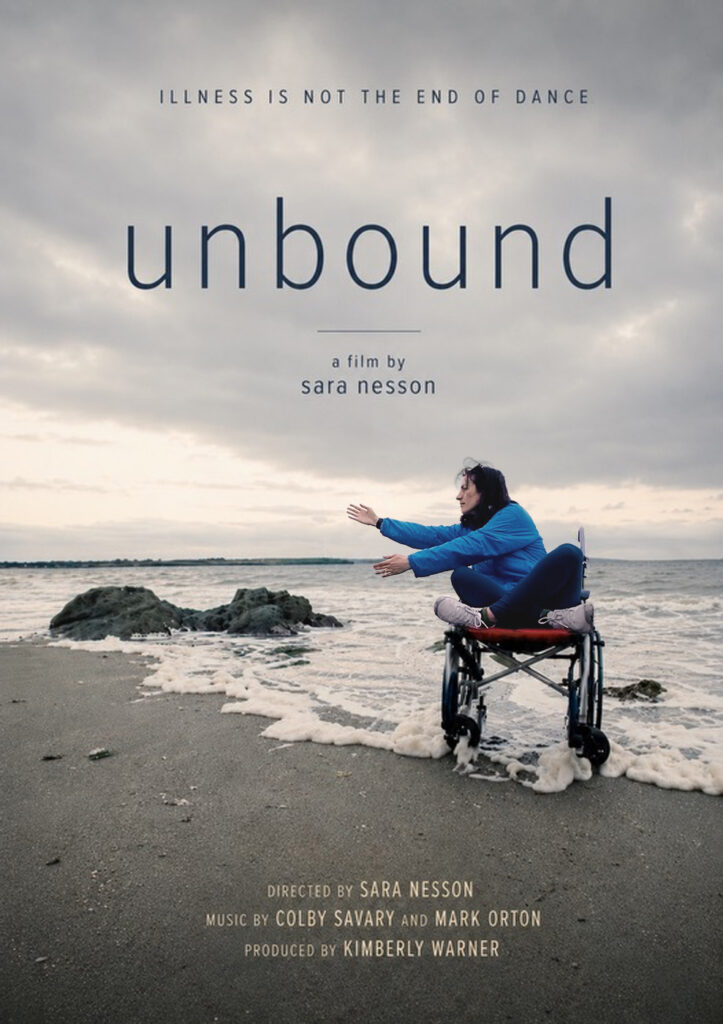
Twenty bodies. One thread of movement. Unbound is a short dance film created by individuals living with ME/CFS and/or Long COVID, exploring the tension between constraint and expression, stillness and vitality.
PREMIERE DETAILS
📅 Wednesday, July 29, 2026
🎥 LIVE Screening: 6:30 PM ET
🎙️ Q&A with cast and creators: 6:45 PM ET
Moderated by Narrative Medicine scholar and essayist Renée Nicholson and presented in partnership with Narrative Mindworks.
Register here: https://www.eventbrite.com/e/unbound-global-premiere-live-qa-tickets-1990987249459
And read on for more…
Unbound is a 6.5-minute dance film that weaves together the movements of twenty individuals living with chronic illness. Inspired by Mitchell Rose’s Exquisite Corps, the film captures short, expressive clips recorded independently by each participant and stitches them into a seamless, evocative choreography.
Through gestures shaped by limitation and longing, the result is a collective act of defiant beauty—a testament to what still moves within us, even when movement is redefined.
Embodied Narrative
Since I got sick with myalgic encephalomyelitis/chronic fatigue syndrome (ME/CFS) over a decade ago, people have thought of me as an embroidery artist and poet who sometimes does piano improvisations. But prior to ME/CFS I was a composer/performer who wrote a lot of music for dancers, sometimes performing with them with my voice, with an instrument, or as a movement artist. I also taught a very physical form of voice work—the Roy Hart method—so most of my days were spent moving in some capacity.
When ME/CFS hit me in the form of an unknown virus, movement became near impossible. In the first few months I had days where chewing was exhausting and even clipped my hair short so I wouldn’t need to wash it daily in order to save energy. It was at this point that I taught myself to embroider. The slow and limited motion of pulling thread through cloth became my movement practice, and as I began to explore free form embroidery in my symptomatology pieces, stitching became a sort of dance.
Illness is not the end of dance.
Through radical rest—thanks to the support of my wonderful husband—and being able to work with a knowledgeable doctor I’ve been able to incorporate more movement into my days. I have a regular bodywork practice—yoga, Feldenkrais, and physio on my better days—but I never did add improvisatory movement back into my practice.
Then Kimberly Warner (producer) told me about Sara Nesson’s Unbound project and all the cells in my body sang an absolute yes to this collaborative process. Sara did an incredible job of prioritizing pacing in the midst of the organizing and filming, and the outcome is an absolutely gorgeous film. Each artist has their own quality of movement and the specificity in editing plus a score by Mark Orton have created a film full of power and poignancy.
Since filming, my primary sclerosing cholangitis (PSC) has progressed so that movement is not a viable option some days. After each biliary infection I gently and mindfully begin moving again, being grateful for what I can manage in the moment. And on days where larger movements aren’t possible I go inwards, in awe of my heartbeat, the waves of my diaphragm, and the small dances I do with my hands.
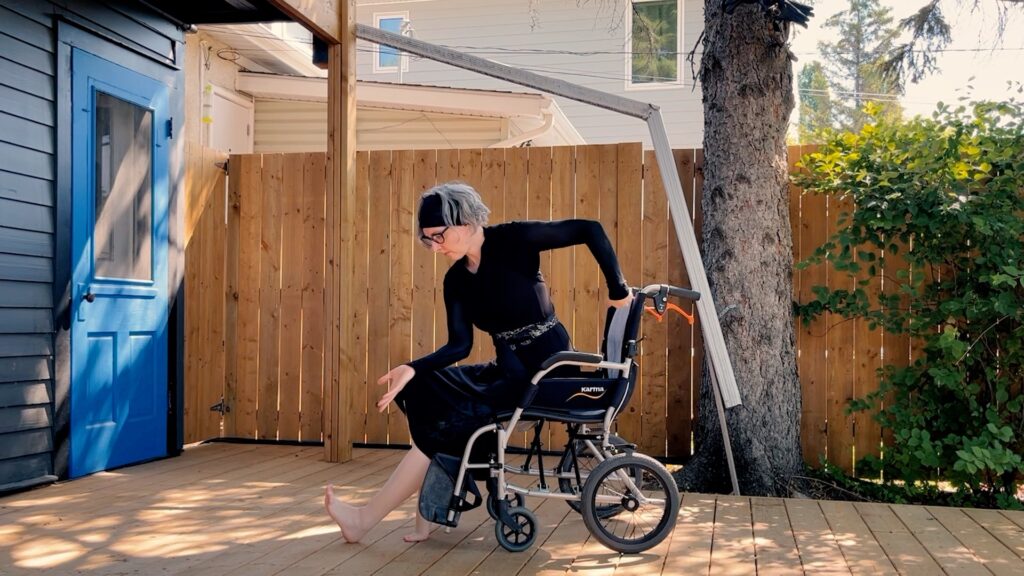
A note on my wheelchair: I am an ambulatory wheelchair user which means I can walk but the chair helps me pace myself when I’m outside the house. My chair is a type of transport chair which requires someone to push me in it. When I’m on my own outside the house I often use it like a rollator and sit on it to rest, or I propel myself with my feet while seated.
When we lived in Japan we saw a Tadashi Suzuki production of King Lear. The actor playing Lear was in a wheelchair and moved so exquisitely on the stage by using his toes on the floor to wheel himself while seated. When Sara asked if anyone wanted to film with their mobility aid I remembered this theatre piece and incorporated Suzuki’s Lear foot movements into my dance.